


Iranian shadow fleet fuels Myanmar junta’s expanding air campaign against civilians
LONDON (Reuters) – The first bomb to strike the remote western Myanmar village of Vanha came from a junta warplane. It hit the only school in the hamlet, near the frontline of Myanmar’s civil war. The second came from a drone minutes later.
On that day, October 13, 2025, an Iranian tanker was headed home from Myanmar, where it had recently unloaded more than 16,000 tons of jet fuel under a cloak of electronic scrambling – enough for thousands more fighter jet sorties.
Illicit Iranian deliveries of jet fuel have powered an expansive bombing campaign by the Myanmar junta that has struck more than 1,000 civilian locations in 15 months, a Reuters investigation has found. Iran has also dispatched cargoes of urea, a key ingredient in the junta’s munitions, including the bombs it drops from drones and paragliders.
Taken together, the Iranian deliveries to Myanmar’s military have helped shift the dynamic of the five-year civil war, which pits the junta against an array of rebel groups, none of which have a conventional air force or a ready supply of weapons as powerful as the bombs and missiles launched by fighter jets. And for Iran’s embattled government, the trade has brought in new revenue and influence, as sanctions tighten and old allies lose power.
By the time the warplane swooped over Vanha and bombed the school, Myanmar’s air force had already received huge quantities of Iranian jet fuel. Two students died that day and 22 people were wounded, according to one of the wounded, a man who was in the schoolyard, and Chin Human Rights Organization, which documents junta attacks in the region.
Most of the children were outside cleaning up the yard at the time, the wounded man said, or the toll would have been far worse. Vanha’s dead were among at least 1,728 civilians killed in government airstrikes since the Iranian deliveries began, according to data compiled by Burma News International-Myanmar Peace Monitor, which tracks the conflict.
From October 2024 to December 2025, Iran delivered a total of about 175,000 tons of jet fuel to the junta in nine shipments from Reef and a larger sister ship, Noble, according to shipping documents reviewed by Reuters, and satellite imagery and analysis by the US firm SynMax Intelligence.
The documents and other shipping data show the two ships sailing out of Iran have been Myanmar’s primary suppliers of jet fuel since the deliveries began. The surge in Iranian imports also includes hundreds of thousands of tons of urea. The petrochemical product is typically a fertilizer ingredient, but Myanmar’s junta also uses it in munitions, according to two soldiers who defected from the military.
Although the intensifying air campaign has been widely documented, Iran’s central role in fueling it and supplying urea has not been previously reported.
The deliveries, which are circumventing Western sanctions on both Iran and Myanmar, are a badly needed crutch for their troubled repressive governments.
The United Nations Special Rapporteur on Human Rights in Myanmar, responding to findings about the Iranian shipments to Myanmar, called for the Iranian government to be held accountable for the actions of its new customer.
“This fuel that is being shipped in from Iran is literally fueling mass atrocities,” Tom Andrews said. “There has been an escalation in attacks on civilian targets. It’s just horrific and unacceptable. It’s important to point out those that are enabling it.”
Iran’s UN mission declined to comment, and Myanmar’s government did not respond. Reporters were unable to reach the owners of Reef and Noble; an email listed as a contact was not valid.
IRAN’S THEOCRACY, reeling from US and Israeli military attacks and the collapse of its currency, has just crushed anti-government protests that posed one of the greatest threats to the Islamic Republic since 1979. It is desperate for money, after years of sanctions.
Myanmar’s military dictatorship is also trying to quell a rebellion that erupted after the junta staged a coup in 2021. The fuel has helped at a critical moment. Its 100 or so warplanes, including Chinese-designed JF-17s, Russian MiG-29s and Sukhoi-30s, are flying far more bombing raids since the fuel trade boomed. Myanmar’s rebels are increasingly struggling to keep control of territory in the face of the junta’s dominance of the skies.
Reef and Noble, both sanctioned by the United States in 2024, started making the roughly 5,500-kilometer voyages from Iran to Myanmar in October of that year, falsifying their journeys using a technique called spoofing that is common among cargo ships and tankers making illicit deliveries.
Since that first delivery until December 31, Myanmar’s military carried out 1,022 airstrikes on civilian targets, more than double the number from the previous 15-month period, according to Myanmar Peace Monitor data. Reuters has not been able to independently confirm the number of airstrikes or civilian casualties.
Vanha’s approximately 260 residents live within a roughly 500-meter radius of the school, and when the airstrike hit, the shock wave rippled through their homes. Video verified by Reuters shows people fleeing when the second explosion rings out from the drone.
The village, ringed by forested mountains, is in Chin state, an impoverished western province bordering India, where the junta is attempting to claw back territory from rebels. Before the year was done, military jets bombed two other schools within 70 kilometers of Vanha, according to the Chin Human Rights Organization.
Most of Vanha’s villagers are now so scared of another airstrike that they sleep in the surrounding jungle and emerge from the tree canopy to return home only when necessary, said the man wounded that day. “Why are they attacking innocent civilians and young children?” he asked.
Reuters could not confirm whether the warplane that struck Vanha was flying on Iranian jet fuel. However, it had been more than a year since the fuel had come from anywhere else, the documents and shipping data show.
The movement of the Iranian ships was tracked using satellite images and analysis provided by SynMax. The data corroborated details listed in the shipping documents, which contained the vessels’ names, cargo, port calls, and arrival and departure dates.
People and companies connected to the terminal where Reef and Noble off-loaded their liquid cargo, near Myanmar’s commercial capital of Yangon, have been sanctioned by the United States, Canada, the European Union, and Britain for supplying jet fuel to the military.
An analyst who tracks Iranian shipping also confirmed some jet fuel deliveries. Some of Reef’s and Noble’s visits to the terminal were further confirmed by Myanmar Witness, a project of the Center for Information Resilience, an organization focused on exposing human rights violations.
Publicly available ship-tracking data and Myanmar Port Authority records also confirmed additional information in the documents, including the deliveries of urea.
Iran’s export surge to Myanmar follows a series of punitive Western export bans on materials that could be used by the junta to repress civilians. Those economic sanctions raised the risks for commercial fuel suppliers and distributors to sell to Myanmar, prompting most to exit the country.
In a response to questions about Iran’s role in supplying Myanmar’s military, the US Treasury Department said Iran’s quest for new markets was a sign that the Trump administration’s economic pressure had been successful. “The regime’s oil profits are being choked,” an official said.
The foreign affairs offices of the EU and Canada declined to comment. Britain’s Foreign Office noted that it had more than 550 sanctions imposed on Iran over its nuclear program and human rights violations, including the Islamic Revolutionary Guard Corps (IRGC) and 25 individuals and 39 entities in Myanmar since the coup.
“The UK condemns human rights violations by the Myanmar military, including airstrikes on civilian infrastructure,” the Foreign Office spokesman said.
Iran has a long history of military support for allies, including Bashar al-Assad in Syria, Hezbollah in Lebanon, Hamas in Gaza, and former president Nicolas Maduro in Venezuela. The sales to Myanmar are part of a broader strategy of extending its influence by deepening ties with other isolated governments – especially after the fall of older allies since the end of 2024, according to analysts. Assad and Maduro are now out of power, and Hezbollah and Hamas are struggling to recover from military defeats by Israel.
The sales also replenish state coffers depleted by the sanctions and Iran’s conflict with Israel. Jet fuel commands a 33% premium compared to Brent crude, meaning Iran could have earned about $123 million for those nine shipments of jet fuel at current market prices, according to estimates based on International Air Transport Association data.
ON SEPTEMBER 15, 2025, Reef’s location transmitter pinged off the southern coast of Iraq near the Basrah Oil Terminal.
Satellite imagery of the area at the time, however, shows no sign of the vessel. Reef was actually at the Iranian port of Bandar Abbas, loading fuel 8 kilometers away from a refinery that produces jet fuel and is overseen by the National Iranian Oil Refining and Distribution Company, known as NIORDC, SynMax satellite imagery shows.
At times, during loading, Reef’s cover slipped and the location transmitter gave away its accurate position, before reverting to the fake location, SynMax data show.
US and EU sanctions documents show NIORDC is a subsidiary of the National Iranian Oil Company, which controls Iran’s petroleum exports and generates huge amounts of money for the IRGC.
The US Office of Foreign Assets Control, the arm of the Treasury Department in charge of sanctions, identified the National Iranian Oil Company as an “agent or affiliate” of the IRGC in 2012.
Reef is part of Iran’s shadow fleet – a network of vessels used to secretly transport illicit cargo. The Iranian fleet ships $50 billion worth of oil each year to customers abroad, by far its largest source of foreign currency and its principal connection to the global economy, Reuters reported in 2024.
The IRGC, with control over both the country’s illicit economy and its internal security, dominates the fuel-smuggling networks and other business interests that have been a lifeline for Iran’s elite. But the organization has provoked popular backlash with its violent suppression of dissent, corruption and stranglehold over the economy, according to analysts and sanctions experts.
Reef and Noble and their owner, Sea Route Ship Management FZE, were sanctioned by the US in 2024 for “knowingly” transporting Iranian petrochemical products. Reef has changed its name and flag of registration three times in as many years – a common tactic in the shadow fleet.
Reef and Noble docked at the Myan Oil Terminal, a facility on the outskirts of Yangon previously known as Puma, SynMax imagery showed. In an archived website, a former corporate owner said it handled 100% of Myanmar’s market for jet fuel, which spoils easily and requires specialized storage and transport.
Western governments have designated the network of companies connected to the facility – including Myan Oil, Swan Energy, Shoon Energy, and Asia Sun Group – as key partners of the junta in importing, storing, and distributing jet fuel. Those firms and two associated individuals, Zaw Min Tun and Win Kyaw Kyaw Aung, were sanctioned for supplying the fuel to the military.
Neither Myan Oil nor the network of companies and people connected to the terminal responded to requests for comment. In many cases, email addresses for them that were listed in the sanctions notices were invalid.
THE SHIFT toward Iranian supplies underscores a broader realignment in relations between Iran and Myanmar’s military, known as the Tatmadaw.
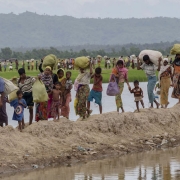
In 2017, Iranian president Hassan Rouhani strongly criticized the Tatmadaw, after it massacred thousands of Rohingya, a mainly Muslim minority. As waves of Rohingya civilians fled to Bangladesh following the military offensive, Rouhani’s administration urged Islamic nations to help end the crisis.
“The international community has no excuse to allow the genocide of Rohingya Muslims to continue in front of our eyes,” Iranian foreign minister Mohammad Javad Zarif said that September.
But after the Tatmadaw ousted the civilian government led by Nobel Peace Prize winner Aung San Suu Kyi in 2021, there was a rapprochement. In January 2022, an Iranian government delegation secretly visited Myanmar to meet with members of the military, according to a regional security source who closely tracks the junta. The visit was first reported by Asia Times.
They were there to sell Iranian weapons, including guided missiles and other military equipment, said the security source, who spoke on condition of anonymity. The source described the visit as a sign that Iran had decided in favor of military support for the junta, while also expanding its arms-export market.
“When push comes to shove, they can make the necessary adjustments,” said Danny Citrinowicz, a former Israeli intelligence officer and now senior Iran researcher at the Institute for National Security Studies think tank, referring to Iran’s pivot to Myanmar. “You can flex the ideology where it’s a strategic interest. And definitely Myanmar is a country that’s interesting to them.”
In addition to increasing jet fuel deliveries, Iran has over the past three years become a primary source of Myanmar’s urea, which the junta has used to manufacture explosives. Three trade analysts who track the imports closely said Iran’s supplies have increased drastically. The annual volume of such Iranian imports into Myanmar could be in the range of 400,000 and 600,000 tons, according to two of them.
At least two vessels that transport bulk cargoes, Golden ES and Rasha, delivered urea from Iran to Myanmar last year, port authority data and satellite imagery show. As with Reef and Noble, Golden ES and Rasha manipulated their onboard location transmitters to disguise their departure point, according to SynMax. The quantities of urea described by the analysts would entail multiple deliveries, but Reuters was unable to confirm other shipments.
The owners of Golden ES and Rasha did not respond to requests for comment.
Major Naung Yoe, a soldier who said he defected from the military in 2021 to avoid killing civilians and joined the rebellion, said urea ends up in two ordnance factories in central Myanmar, where it can be integrated into multiple kinds of explosives, including bombs dropped from drones and paragliders. Another defected soldier confirmed the urea-based munitions.
Deepening commercial ties have been accompanied by recent high-level political engagement between Myanmar and Iran.
In December 2025, Iranian President Masoud Pezeshkian sat across from Myanmar’s Prime Minister Nyo Saw on the sidelines of a summit in Turkmenistan. An Iranian readout of the meeting said Nyo Saw emphasized the desire to expand cooperation in oil imports and extraction technology.
Iran was also invited to send monitors to observe Myanmar’s phased general election that started on December 28, 2025. It was a vote that the opposition, the UN, and many international observers described as neither free nor fair. Myanmar’s junta has said the election was successful and broadly popular.
AS THE election approached, the Tatmadaw continued its aerial bombardment of civilian areas.
Wai Hun Aung, an aid worker, was at home late on December 10 when he heard a plane flying overhead. Moments later, a massive explosion shook his house in Mrauk-U town in Rakhine state, a coastal province bordering Bangladesh where the military has been locked in fierce fighting with the Arakan Army rebel group.
“I was terrified. I knew instantly that we were being targeted by an airstrike,” Wai Hun Aung said.
It was not until dawn, when he reached the town’s main hospital on his motorbike, that the aid worker grasped the scale of destruction.
Relatives of patients swarmed the wreckage of the hospital, looking for survivors, he said. At least 30 people were killed and more than 70 wounded, according to Reuters reporting. It was among the deadliest aerial attacks of the civil war.
Only days earlier, Reef had made another covert delivery to Myanmar, unloading nearly 15,000 metric tons of jet fuel, according to the documents and satellite images. As on previous trips, the crew spoofed its location to falsely show it was sailing from Iraq’s Basrah Oil Terminal to Chittagong in Bangladesh.
A port authority official in Chittagong said he wasn’t aware of the spoofing operation. Iraq’s government did not respond to requests for comment.
Picking his way through the rubble that morning, Wai Hun Aung said he found bodies and severed limbs scattered across what had been wards and operating theaters in a 300-bed hospital.
“It felt like the end of the world,” he said in a series of audio messages, “the sound of crying from outside and the sight of the bodies inside.”
The hospital in Mrauk-U lies in ruins, but the tankers that enabled the destruction keep moving. In late January, as the Iranian protests were crushed, SynMax data showed Noble again pretending to be anchored off the southern tip of Iraq. In reality, the ship was loitering near the Iranian port of Bandar Abbas, waiting to set sail. was loaded and on its way back toward Yangon.



Trackbacks & Pingbacks
read about tadalafil brands
read about tadalafil brands
orlistat food interactions
orlistat food interactions
vardenafil vs sildenafil comparison review
vardenafil vs sildenafil comparison review
sildenafil formulation cost impact
sildenafil formulation cost impact
ivermectin kinetic summary
ivermectin kinetic summary
ivermectin health overview
ivermectin health overview
terbinafine side effects expert overview
terbinafine side effects expert overview
flagyl tablet dosage
flagyl tablet dosage
semaglutid tabletten handelsname
semaglutid tabletten handelsname
sémaglutide oral perte de poids
sémaglutide oral perte de poids
dutasteride used for
dutasteride used for
prescription strength omeprazole
prescription strength omeprazole
lasix water pill
lasix water pill
lamictal
lamictal
sertraline hcl 25 mg cost
sertraline hcl 25 mg cost
fluconazole for yeast infection over the counter
fluconazole for yeast infection over the counter
fluconazole 150 mg oral tablet
fluconazole 150 mg oral tablet
ciprofloxacin hcl 500 mg
ciprofloxacin hcl 500 mg
Comments are closed.