Eight Years On: Protection and Justice for the Rohingya Cannot Wait
Escalating hunger, other atrocities in Rakhine State demand urgent, coordinated international action now
25 August 2025
In commemoration of eight years since the Rohingya genocide committed by the Myanmar military in 2017, we—Blood Money Campaign, Defend Myanmar Democracy, and Progressive Voice—reaffirm our solidarity with the Rohingya community. We pledge to continue to stand with the Rohingya, strongly advocating for protection, justice, and their safe, voluntary and dignified return to their homeland of Myanmar. Such a return will only be possible once genuine and inclusive federal democratic governance is established.
We call on the international community to restore and increase aid for the Rohingya; implement cross-border aid into Rakhine State; advance justice and accountability through all available avenues to stop the ongoing genocide; and robustly support the Myanmar people’s democratic aspirations. We specifically urge the International Criminal Court (ICC) to issue an arrest warrant for Min Aung Hlaing, and we urge the ICC Prosecutor to request arrest warrants for other perpetrators, following Argentina’s lead, without further delay.
Worsening Crises in Rakhine State, Bangladesh Camps
Eight years ago, the Myanmar military carried out a calculated and horrific genocide against the Rohingya in Rakhine State—committing mass killings, widespread rape and other forms of sexual violence, torture, and the systematic destruction of villages. These so-called “clearance operations” drove more than 750,000 Rohingya to seek refuge in Bangladesh, joining more than 300,000 Rohingya who had fled earlier waves of persecution by the military. Today, approximately one million Rohingya are suffering deplorable, inhuman conditions in overcrowded, unsafe refugee camps in Bangladesh.
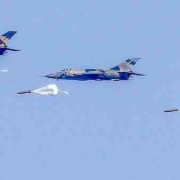
Genocidal violence against the Rohingya continues in Myanmar today—particularly in Rakhine State, where the military junta is using starvation as a weapon of genocide. Over the past year, the junta has been intentionally blocking the delivery of food, medicine, and other basic necessities to Rohingya communities. At the same time, the military junta continues to deliberately bomb Rohingya villages, forcibly conscript Rohingya youth and men, and extort Rohingya communities at every turn.
The Arakan Army (AA) has also committed grave human rights violations against the Rohingya in Rakhine State, including arson attacks, forced displacement, extrajudicial killings, restrictions on movement and agriculture, and forced recruitment. The recent discovery of a mass grave in Buthidaung—indicating that hundreds of Rohingya were massacred on 2 May 2024 by the AA—highlights the urgent need to advance justice and accountability to prevent further atrocities against the Rohingya.
Across Rakhine State, Rohingya communities are on the brink of famine—starving, desperate, and trapped by cycles of violence and persecution by the military junta and the AA. Massive cuts to international humanitarian funding, particularly by the United States, have exponentially compounded the Rohingya’s suffering, leading to dramatic increases in hunger and malnutrition. According to the Burmese Rohingya Organisation UK, as of late April 2025, “as many as 70 percent of [internally displaced persons] were reported to be facing starvation in some Sittwe [internment] camps,” in which the military has confined nearly 112,000 Rohingya, forcing them to be entirely dependent on international aid.
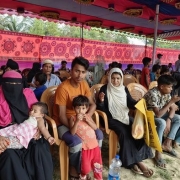
In Bangladesh, conditions in the Rohingya refugee camps have grown even more dire, with more than one million people facing extremely severe food shortages, violence, internet shutdowns, and heavy restrictions on movement. Callous and abrupt aid cuts are accelerating this major humanitarian disaster; funding has been slashed for food rations, health care, and education, exacerbating refugees’ extreme vulnerabilities. For the 437,000 school-age Rohingya children in the camps, the closure of thousands of learning centers in mid-2025 has deepened an already severe education crisis, forcing many children out of school and into the hands of armed groups and traffickers. Representing more than 75% of the refugee population, women and children remain at heightened risk of sexual and gender-based violence, human trafficking, and other grave abuses, while the collapse of basic health services has left countless refugees without access to lifesaving treatment or basic medications.
The international community, particularly the UN, must act now to protect the Rohingya. We call on the international community to immediately restore and increase aid for the Rohingya—including in Rakhine State and in Bangladesh refugee camps. Cross-border aid from Bangladesh to Rakhine State must be urgently implemented, and it must be ensured that this international aid reaches Rohingya communities inside Myanmar.
International Justice, Formal Recognition for the Rohingya
For the safe, voluntary, and dignified return of the Rohingya to Myanmar to be possible, justice and accountability are essential. The perpetrators of atrocity crimes against Rohingya must be held accountable through all available avenues and without further delay.
In this vein, we welcome the Argentine judiciary’s issuance of arrest warrants for 25 Myanmar military leaders and civilian government officials as part of the judiciary’s ongoing investigation into the atrocity crimes committed against the Rohingya in Myanmar from 2012 to 2018. This is the first time that arrest warrants have been ordered in relation to the Myanmar military’s genocide against the Rohingya in 2017. We, likewise, commend the Office of the Prosecutor of the ICC for its landmark application for an arrest warrant, dated 27 November 2024, against junta chief Min Aung Hlaing. These are critical and momentous steps towards justice for the Rohingya.
We call on the judges of the ICC to swiftly grant the Prosecutor’s request and issue an arrest warrant against Min Aung Hlaing as soon as possible. We also call on the Prosecutor to request arrest warrants for other perpetrators. In tandem, we call on the international community to support and expedite the Myanmar people’s and international efforts to hold the perpetrators of atrocity crimes in Myanmar to account. The international community must also take additional concrete actions to advance justice and accountability, namely a State Party Referral of the crisis in Myanmar to the ICC under Article 14 of the Rome Statute.
Furthermore, at the UN’s High-level Conference on 30 September 2025, the international community must adopt a concrete, actionable plan—developed with the National Unity Government, the United League of Arakan/AA, and Rohingya community leaders—to ensure the Rohingya’s safe, dignified, and voluntary return to Myanmar; the restoration of their citizenship; and their full protection. This action plan must affirm their identity as Rohingya and formally recognize them as both an ethnic group of Myanmar and an equal political stakeholder in the country’s federal democratic future.
Safe Return, Equal Rights through Federal Democracy
The safe, voluntary, and dignified return of the Rohingya to Myanmar is also inextricably linked to the Myanmar people achieving their collective goal of establishing inclusive federal democracy. Only a democratic system that guarantees equal rights, justice, and the restoration of citizenship for the Rohingya can create the conditions necessary for the Rohingya’s safe, voluntary, and dignified return to their homeland. Without such systemic change, including the dismantling of the Myanmar military, the structures and institutions that have enabled persecution and mass atrocities will remain intact—leaving the Rohingya vulnerable to renewed violence and displacement. We urge the international community to take concrete actions to support the Myanmar people in their ongoing efforts to build inclusive federal democracy and sustainable peace from the ground up.
We will continue to stand in solidarity with the Rohingya community, honor our diversity and common humanity, and commit to building an inclusive federal democratic Myanmar—grounded in peaceful coexistence, mutual respect, support, and the recognition of equal dignity and rights.
For more information, please contact:
Mulan, Blood Money Campaign; bloodmoneycampaign21@protonmail.com
Naw Aung, Defend Myanmar Democracy; communication@defendmyanmardemocracy.org
Khin Ohmar, Progressive Voice; info@progressive-voice.org