Democracy Dies Where Dictators Thrive
Human Rights Violations by the Military Junta Post-Sham Election
More than five years after the attempted coup in Burma on 1 February 2021, coup leader Min Aung Hlaing declared himself president on 3 April 2026.[1] Weeks later, on April 20, the junta announced a ‘100-Day Plan’ outlining its intention to seek peace, economic recovery, and infrastructure modernization, and to invite armed groups to negotiations.[2] This is the latest sham effort by the junta to mislead the international community with diplomatic theatre that lacks credibility, especially as conflict continues to rage across most of the country.
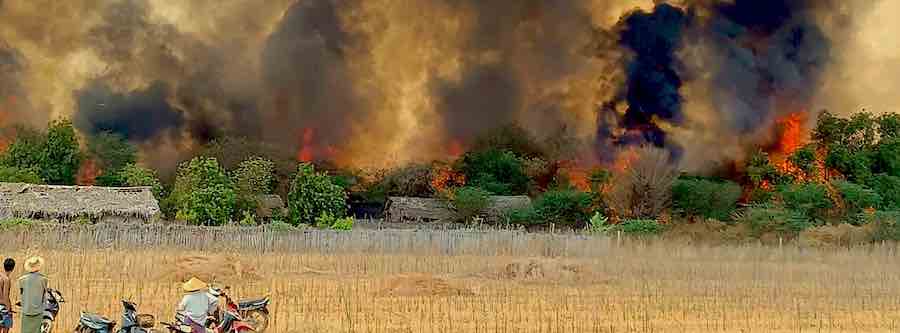
Min Aung Hlaing’s self-appointment led him to claim that “Myanmar has returned to the path of democracy.”[3] Such a statement deliberately ignores the devastating impacts of human rights on civilians. A civil war waged by the junta has plunged thousands into irreversible poverty, decimated progress towards gender equality and protections for the most vulnerable, and eroded livelihood pathways, such as agriculture, on which the majority of civilians in rural areas depend to sustain themselves. The international community must not be fooled. In the short period between early April and mid-May 2026, despite the junta’s so-called commitment to ‘peace and security,’ attacks against civilians were widespread. Over 140 civilians have been killed by airstrikes alone since the 100-day peace announcement, with nearly 300 aerial attacks taking place between 20 April and 1 June.[4]
The suffering of the nation’s people has not been of concern to the dictators of Burma, who have continued to seek illicit pathways to grow their profits at the cost of local lives. Military-aligned companies have consolidated economic control, allowing them to prosper despite facing several sanctions across Europe and North America. By extension, crony companies serve as key joint venture partners and de facto regulators for state-owned enterprises overseen by the junta’s Ministry of Natural Resources, facilitating the lucrative extraction and export of minerals that are mined on the backs of local workers, who are underpaid, exploited, and employed as day labourers in resource-rich regions of the country.[5]
While millions displaced are subjected to immense hardships, including a lack of clean water, adequate shelter and nutrition, a rigged and corrupt election resulted in yet another illegal power-grab that the terrorist regime is now using as a catapult to assert legitimacy through the Association of Southeast Asian Nations (ASEAN) and international stakeholders. While ASEAN did not formally recognize the sham election, problematic engagement has increased since coup leader Min Aung Hlaing made himself President, including through diplomatic outreach. Thailand, in particular, has sought to bring Burma back into the regional bloc by encouraging its invitation to various summits and meetings.[6] The junta also continues to seek support from China, Russia and India to leverage their position.
As the junta embraces their illegal rule, it is critical to note that voting did not take place in every part of the country due to conflict ravaging many areas, making it impossible to cast ballots.[7] Nevertheless, the junta has insisted that their supposed victory was a ‘landslide.’ In reality, extractive and intimidating practices were carried out by junta supporters and members of the Burma Army to violently coerce civilians in local villages and towns to vote for the pro-military Union Solidarity and Development Party. [8]
In addition, the hijacking of the legal system continued with laws going into effect which directly undermined voter independence and integrity, including the Law on the Protection of Multiparty Democratic General Elections, which criminalized speaking out or inciting violence against the election or election workers.[9] Jail sentences for those found guilty were three years to a maximum of life imprisonment or even the death penalty.[10] This blatant weaponization of the rule of law led to the unlawful detainment of civilians.[11]
Attacks also dramatically increased in areas where the junta was seeking to control areas to hold voting, where once again civilians were forced to bear the impact of the junta’s volatility.[12] In the lead-up to the December 2025 vote, the military engaged in a widespread civilian-targeting campaign, recording over 210 deadly attacks that resulted in at least 191 civilian fatalities between December 28, 2025 and late January 2026.[13]
Prior to the sham election, the former UN Special Rapporteur on the situation of human rights in Myanmar, Tom Andrews, unequivocally rejected the military junta’s so-called election, declaring it neither free, fair, nor legitimate.[14] There were also warnings to observers that this election would be rigged as it occurred with ‘total surveillance.’[15] “To endorse an election under these conditions is to endorse both physical and digital repression,” stated ND-Burma member organization, the Human Rights Foundation of Monland.[16]
While the junta moves to expand its presence in parliament, loyalists to the regime are carrying out an authoritarian agenda in which human rights violations are being perpetrated daily. The democratic opposition and the emerging federal bodies have been branded ‘armed terrorist factions,’ and face daily threats to their well-being and security. Thousands have been killed in the last five years, with the situation looking to only worsen as 16 million people are in need of life-saving humanitarian assistance.[17]
Further, this briefing paper by the Network for Human Rights Documentation-Burma (ND-Burma) will draw on a combination of desk research, cases, and case studies from our member organizations to highlight how military impunity persists in the aftermath of the sham election and, specifically, how human rights violations have continued since the junta announced its 100-Day plan.
It is clear that the ruling regime has no intention of promoting or protecting human rights. ND-Burma strongly calls on the international community not to be fooled by the election, which not only lacked transparency but also failed to meet basic electoral standards. [18] As human rights violations continue, accountability is needed to ensure justice for victims.