Myanmar Civil Society Presses World Bank to Engage Democratic and Ethnic Governance Actors and Open Dialogue at 2026 Annual Meetings
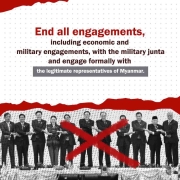
A delegation of Myanmar civil society organizations joined the 2026 IMF-World Bank Annual Meetings in Bangkok this week, calling on the World Bank Group to engage democratic and ethnic governance actors in Myanmar that are building a federal democracy from the ground up, with territorial control, administrative functions, and effective public service delivery systems, and to conduct a formal dialogue with Myanmar civil society under the Bank’s new Fragility, Conflict and Violence Strategy.
The World Bank scaled down its country programming in response to the fragile and active violence in Myanmar since the attempted military coup of February 2021. Despite the enormous contextual and operational risks, the World Bank has maintained its presence in the country, as highlighted by the operation of six humanitarian and resilience projects approved by the Board and management over the last five years. These projects have been implemented by third-parties that are mainly international humanitarian organizations. However, there is no clear partnership framework that enables democratic and governance actors and local civil society organizations involved in project design, management and delivery to manage risks and meet targeted results.
At the Civil Society Townhall on 12 October, Khin Ohmar, Founder and Acting Executive Director of Progressive Voice, directly asked World Bank Group President Ajay Banga why they have not engaged democratic governance actors and civil society as part of its Myanmar projects to help manage the safeguards and integrity risks necessary to avoid compromising these projects. President Banga was also asked to instruct his Myanmar team to answer Myanmar civil society organizations’ April 2026 letter and repeated meeting requests.
The delegation also held meetings with the executive director’s offices of the World Bank. They were provided with a contextual update on Myanmar in relation to the Bank’s projects and were asked to use their leverage to ensure that the Bank engages with local and regional governance actors outside military junta control. The Bank must open a series of constructive dialogues with Myanmar civil society and maintain the current policy that no Bank funds, whether grants, administered trust funds, or concessional loans, flow through junta-controlled systems. The Bank must have a clear partnership framework with Myanmar CSOs and local democratic actors in humanitarian and resilience initiatives and engage independent third-party monitors to ensure aid reaches the target communities, responds to priority needs, and avoids being instrumentalized to discriminate against civilians.
Khin Ohmar, Founder and Acting Executive Director of Progressive Voice, said: “Myanmar’s vibrant civil society groups have had long-standing engagement with the Bank since before 2010, when the Bank developed its Myanmar’s interim country strategy note for the reengagement with the country. Now, with the military junta’s active campaign of violence against civilians while it actively bids for international legitimacy under civilian disguise, Myanmar is a test case for the Bank’s Fragility, Conflict and Violence (FCV) Strategy. The Bank must engage with civil society operating outside military control to give input into the operationalization of the 2026-2030 strategy into the Myanmar context so the Bank can implement its humanitarian responses through third parties with integrity, safeguards, and meaningful objectives.”
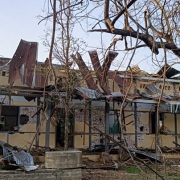
Shwe Shwe Sein Latt, Director of Creative Home, stressed: “The March 2025 Sagaing earthquake taught an important lesson for the Bank: Work with local actors to reach people struggling to survive from disasters. Myanmar’s civil society organizations, alongside local responders, reached affected communities within 48 hours despite huge personal risks. Had the Bank enabled the participation of local democratic actors from design to implementation and monitoring, its response could have provided a genuine lifeline for more communities severely hit by recent disasters.”
Han Gyi, Coordinator of Network for Human Rights Documentation – Burma (ND-Burma), emphasized: “Engaging local and regional governance units is critical. Even where the World Bank’s humanitarian response projects since 2021 have been implemented by international humanitarian organizations, we have witnessed and reported gaps in transparency, consultation, and implementation arrangements, compromising the effectiveness and impact they seek to deliver. We asked whether their office would support engaging well-established, capable, functioning, tested, and people-supported governance units as service delivery partners to ensure aid is not weaponized to discriminate against people or perpetuate the military junta’s abusive system.”
ET, Program Manager of Nyan Lynn Thit Analytica, highlighted: “The military junta is bombing schools and clinics, which means Myanmar’s human capital and future are being destroyed. On top of these atrocities, at least 100,000 young people have been forced into conscription, torn from their workplaces and schools, some used as human shields and forced laborers. At the same time, children in conflict-affected areas are cut off from basic health services like vaccination because the junta weaponizes aid and discriminates in its distribution. The Bank cannot reach these children and youth through junta-controlled systems. The Bank must work with the local governance actors and civil society that are capable of co-delivering such services with safeguards and accountability.”
For more information, please contact:
- Khin Ohmar, Progressive Voice; info@progressive-voice.org
- Shwe Shwe Sein Latt, Creative Home; director@chmyanmar.org
- Han Gyi, Network for Human Rights Documentation – Burma; hangyi@ndburma.org
- ET, Nyan Lynn Thit Analytica; eit@nyanlynnthit.org